
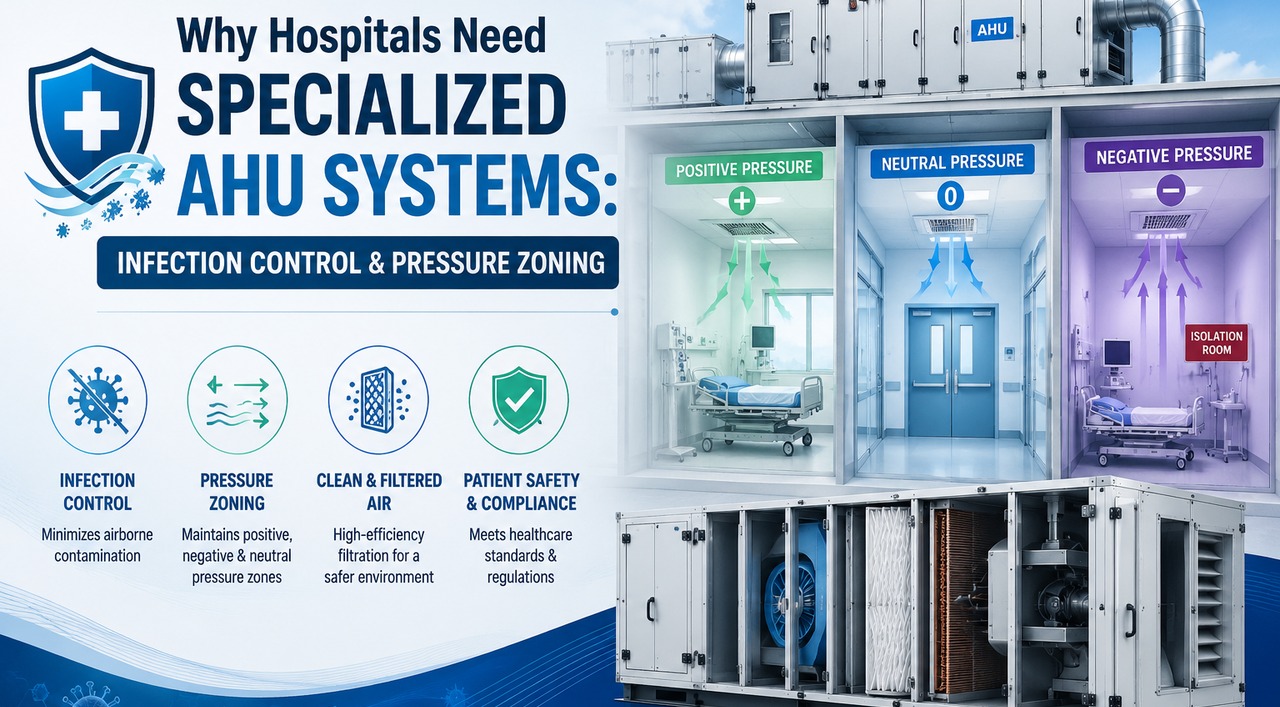
Hospital-acquired infections (HAIs) are one of the leading causes of preventable patient harm worldwide. According to the World Health Organization (WHO), hundreds of millions of patients are affected by HAIs each year — and a significant proportion of these infections are transmitted through the air. Poor ventilation, inadequate filtration, and improper air pressure management can turn a hospital’s air system into a vehicle for spreading bacteria, viruses, and fungal spores from one zone to another.
This is why a standard commercial air handling unit (AHU) — the kind used in offices, hotels, or shopping malls — is fundamentally unsuitable for a hospital environment. Healthcare facilities require purpose-built, hospital-grade AHU systems designed specifically for infection control, precise pressure zoning, sterile filtration, and 24/7 operational reliability.
In this blog, we cover everything hospital facility managers, project consultants, and healthcare administrators need to know about specialized hospital AHU systems — including how pressure zoning works, what HEPA filtration means in practice, zone-wise AHU specifications, and the compliance standards you must meet in India.
Why Standard Commercial AHUs Fail in Hospital Environments
Commercial AHUs are engineered for one primary purpose: human thermal comfort. They are designed to maintain a comfortable temperature and basic air quality in spaces like offices, retail stores, and hotels. While they do this job well in those environments, they are completely inadequate when placed inside a hospital.
Here is why:
- Low air change rates (ACH): Commercial AHUs typically deliver 4–8 air changes per hour. Hospitals require 12–25 ACH depending on the zone — a fundamental design difference.
- No pressure control: Standard AHUs have no mechanism to create and maintain positive or negative pressure zones, which are essential to prevent cross-contamination between clean and infected areas.
- Basic filtration: Commercial units use MERV 8–11 filters that capture dust and large particles. They cannot filter bacteria, viruses, or fine aerosols. Hospitals require HEPA H13/H14 grade filtration.
- No redundancy: A hospital AHU must never fail. Commercial units are not designed with dual-fan setups or backup systems, making them unsuitable for life-critical environments.
- Standard casing: Commercial AHU casings often have ledges, joints, and surfaces that collect dust and microbial growth. Hospital AHUs use smooth hygienic casings with antimicrobial coatings.
- Recirculation risk: Commercial AHUs recirculate return air freely. In isolation rooms and infection wards, this is dangerous — 100% exhaust of air to the outdoors is required.
Commercial AHU vs Hospital AHU — Key Differences at a Glance
| Parameter | Standard Commercial AHU | Hospital-Grade AHU |
| Air Changes per Hour (ACH) | 4–8 ACH | 12–25 ACH (zone-dependent) |
| Filtration Grade | MERV 8–11 (basic dust) | HEPA H13/H14 (99.95%+ efficiency) |
| Pressure Control | No pressure zoning | Positive/negative zoning with BMS monitoring |
| Redundancy | Single unit, minimal backup | Dual-fan, parallel AHUs for critical areas |
| Casing / Build | Standard galvanised steel | Hygienic casing, antimicrobial coating, no ledges |
| Exhaust Recirculation | Return air recirculated freely | 100% exhaust in isolation rooms — no recirculation |
| Design Purpose | Comfort cooling & heating | Infection prevention, sterility, and compliance |
Understanding Pressure Zoning in Hospital HVAC Design
Pressure zoning is the single most important concept in hospital HVAC design. It refers to the deliberate engineering of air pressure relationships between different areas of a hospital — so that air always flows from clean areas toward less-clean areas, and never the other way around.
Think of it this way: if you open a door between a sterile operating theatre and a corridor, which way should air flow? Outward from the OT — so that contaminants from the corridor cannot enter the sterile field. This is achieved through positive pressure. Conversely, in an isolation ward where an infectious patient is housed, air must flow inward — so that pathogens cannot escape into the corridor. This is negative pressure.
Hospital AHU systems are specifically engineered to create, maintain, and monitor these pressure relationships continuously. Here is how each type works.
Positive Pressure Rooms — Keeping Sterile Areas Contamination-Free
Positive pressure rooms are used in areas where the highest level of sterility must be maintained and where the patient or environment must be protected from outside contaminants.
Where positive pressure is used:
- Operating theatres (OTs) and surgical suites
- Intensive Care Units (ICUs)
- Bone marrow transplant and immunocompromised patient wards
- Pharmacy clean rooms and sterile preparation areas
How it works: The AHU supplies more air to the room than is exhausted. This creates a higher air pressure inside relative to adjacent corridors and rooms. When a door opens, air rushes outward — preventing corridor air and its contaminants from entering the clean space.
Typical specifications: +15 to +20 Pascal (Pa) pressure differential, 20–25 ACH, HEPA H14 filtration with laminar (unidirectional) airflow in OTs.
Negative Pressure Rooms — Containing Infectious Zones
Negative pressure rooms are used where an infectious patient must be isolated to prevent airborne pathogens from spreading to other parts of the hospital.
Where negative pressure is used:
- Airborne Infection Isolation Rooms (AIIR) for TB, measles, COVID-19
- Isolation wards for highly infectious diseases
- Autopsy rooms and pathology laboratories
- Certain radiology and bronchoscopy suites
How it works: The AHU exhausts more air from the room than it supplies. This creates a lower pressure inside relative to the corridor. When a door opens, air rushes inward — containing any infectious particles within the room and preventing them from escaping.
Minimum specifications: -8 Pa pressure differential, minimum 12 ACH for new or renovated spaces, 100% direct exhaust to outdoors (no recirculation of exhaust air), with anteroom airlocks between the isolation room and the corridor.
Pressure Cascade — How Hospital Zones Connect Safely
A well-designed hospital does not simply have some positive and some negative rooms in isolation. It has a carefully engineered pressure cascade — a hierarchy of pressure levels across connected zones, ensuring air always moves from the cleanest area to the least clean.
A typical OT pressure cascade works as follows: The operating theatre is at +20 Pa, the scrub room at +15 Pa, the clean corridor at +10 Pa, and the general corridor at atmospheric pressure (0 Pa). Air flows outward at every step — making it physically impossible for contaminated corridor air to reach the sterile field.
Maintaining this cascade 24/7 requires real-time monitoring through a Building Management System (BMS), pressure sensors at every critical room, self-closing sealed doors, and regular recommissioning — because pressure differentials can drift over time due to building settlement, filter loading, and door wear.
HEPA Filtration — The Frontline Defence Against Airborne Infections
Air filtration is the second pillar of hospital infection control after pressure zoning. In a hospital, the air supply to critical zones must be filtered to a level that removes bacteria, fungal spores, and fine aerosols that carry viruses.
This is where HEPA (High Efficiency Particulate Air) filters come in. A HEPA H13 filter captures at least 99.95% of all airborne particles at 0.3 microns — the most penetrating particle size. A HEPA H14 filter captures 99.995% of particles at 0.3 microns. To put this in context, the tuberculosis bacterium (Mycobacterium tuberculosis) is approximately 0.5–5 microns. Fine respiratory aerosols carrying viruses range from 0.1–10 microns. Standard MERV 11 commercial filters cannot capture these.
Where HEPA Filtration Is Mandatory in Hospitals
- Operating theatres: HEPA H14 with laminar airflow — air delivered as a smooth, unidirectional curtain from ceiling to floor over the surgical field.
- ICU and critical care: HEPA H13 terminal filters at supply air diffusers.
- Bone marrow transplant and immunocompromised units: HEPA H14 — patients have virtually no immune system and are at extreme risk from even trace airborne pathogens.
- Isolation rooms (AIIR): HEPA H13 on exhaust side, preventing pathogens from entering ductwork before air is discharged outdoors.
- Pharmacy sterile preparation areas: HEPA H14 with laminar flow hoods.
MERV Ratings for General Hospital Areas
Not every part of a hospital requires HEPA. General wards, OPD areas, and administrative zones use MERV 13–16 filters as a minimum — sufficient for general air quality without the cost of full HEPA. A multi-stage filtration approach is common: a pre-filter (MERV 8) catches large particles, an intermediate filter (MERV 13) handles finer dust, and a terminal HEPA filter handles critical zones.
UV-C Sterilisation — A Complement, Not a Replacement
Some modern hospital AHUs incorporate UV-C germicidal irradiation within the air handling unit — exposing airborne pathogens to ultraviolet light that damages their DNA, preventing reproduction. UV-C is effective against a broad range of bacteria and viruses and can extend filter life by keeping coils and duct surfaces sterile.
However, UV-C is an adjunct — not a replacement for HEPA filtration or negative pressure. Where HEPA filtration and proper pressure relationships are required by NABH or ASHRAE 170, UV-C cannot substitute for them.
Zone-Wise AHU Requirements Across Hospital Areas
One of the most common mistakes in hospital HVAC planning is treating the entire building as a single zone. Each area of a hospital has distinct clinical requirements — and the AHU specification must reflect this. Below is a summary of the key AHU parameters by hospital zone.
| Hospital Zone | Min. ACH | Pressure | Filtration | Temp / RH |
| Operating Theatre | 20–25 | Positive (+20 Pa) | HEPA H14 + Laminar | 18–22°C / 50–60% |
| ICU / Critical Care | ≥15 | Positive (+15 Pa) | HEPA H13 terminal | 21–24°C / 40–60% |
| Isolation Ward (AIIR) | ≥12 | Negative (−8 Pa) | HEPA H13, 100% exhaust | 22–26°C / 30–60% |
| General Ward | 6–10 | Neutral / slight positive | MERV 13+ | 22–26°C / 40–60% |
| OPD / Corridors | 4–6 | Neutral | MERV 11–13 | 23–27°C / 40–60% |
Note: These are general reference parameters based on ASHRAE 170 and NABH guidelines. Specific project requirements may vary based on the authority having jurisdiction (AHJ), hospital type, patient profile, and accreditation body. Always verify with your HVAC consultant and commissioning authority.
Compliance Standards Every Hospital HVAC System Must Meet
Hospital AHU systems in India and globally must comply with a framework of standards that govern ventilation rates, pressure relationships, filtration, and documentation. Non-compliance does not just affect accreditation — it creates direct patient safety risks.
NABH Guidelines (India)
The National Accreditation Board for Hospitals and Healthcare Providers (NABH) sets the compliance framework for hospitals seeking accreditation in India. NABH standards address infection control in facility management, requiring hospitals to maintain documented HVAC maintenance records, air quality monitoring, and compliance with pressure and ACH requirements for critical areas. Hospitals undergoing NABH accreditation or re-accreditation must demonstrate functioning, well-maintained AHU systems with verifiable records.
ASHRAE Standard 170 — Ventilation of Health Care Facilities
ASHRAE 170 is the globally recognised technical standard for hospital HVAC design. It specifies minimum outdoor air quantities, air change rates, pressure relationships, filtration grades, and temperature and humidity ranges for every functional area of a healthcare facility — from operating theatres and ICUs to corridors and waiting areas. ASHRAE 170 (2021 edition) is the reference standard used by most Indian hospital HVAC consultants and is increasingly cited by NABH and Joint Commission International (JCI) accreditation processes.
Commissioning, TAB, and Ongoing Re-commissioning
Installing a hospital AHU system is not enough — it must be formally commissioned. Commissioning involves:
- Test and Balance (TAB): Verifying that actual air flow rates, pressure differentials, and temperatures match design specifications at every room and zone.
- BMS Integration: Connecting pressure sensors, airflow meters, and temperature/humidity sensors to a centralised Building Management System that logs and alarms deviations.
- Documentation: Producing verifiable commissioning records — the pressure differential logs, filter replacement history, and corrective action documentation required for NABH and JCI inspections.
- Periodic re-commissioning: Pressure differentials drift over time. Critical zones should be re-commissioned annually at minimum, or after any major building renovation.
Frequently Asked Questions
Q1. How many air changes per hour (ACH) does a hospital operating theatre need?
A hospital operating theatre requires a minimum of 20–25 air changes per hour (ACH) as per ASHRAE 170 and NABH guidelines. This high rate ensures that any contaminants introduced into the sterile field — from surgical instruments, staff movement, or equipment — are rapidly diluted and removed. OTs also require HEPA H14 filtration with laminar (unidirectional) airflow to deliver air in a clean, downward curtain across the surgical site.
Q2. What is the difference between positive and negative pressure rooms in a hospital?
Positive pressure rooms supply more air than they exhaust, creating higher internal air pressure that pushes air outward when a door opens — protecting the room from outside contaminants. They are used in OTs, ICUs, and transplant wards. Negative pressure rooms exhaust more air than they supply, creating lower internal pressure that draws air inward when a door opens — containing infectious particles within the room. They are used in isolation wards, AIIR rooms for TB or COVID-19, and autopsy areas.
Q3. Can a standard commercial AHU be installed in a hospital to save cost?
No. A standard commercial AHU cannot meet the infection control requirements of a hospital environment. It lacks HEPA filtration, pressure control capability, the required ACH capacity for clinical zones, and the redundancy required for life-critical operations. Using a commercial AHU in an OT or ICU would compromise patient safety, fail NABH inspection, and create serious legal and operational liability for the hospital. The upfront cost difference of a hospital-grade AHU is marginal compared to the cost of an HAI outbreak or accreditation failure.
Q4. What HEPA filter grade is required for a hospital operating theatre?
Hospital operating theatres require HEPA H14 grade filtration — capturing a minimum of 99.995% of particles at 0.3 microns. This is typically delivered through a multi-stage system: a coarse pre-filter (MERV 8) and intermediate filter (MERV 13) upstream in the AHU, followed by terminal HEPA H14 filters at the ceiling supply diffusers directly above the surgical field. Laminar airflow (unidirectional, downward) is also required to deliver clean air as a continuous, undisturbed curtain over the patient.
Q5. What are the NABH HVAC requirements for hospitals in India?
NABH requires hospitals to maintain documented evidence of HVAC compliance as part of its Facility Management and Safety (FMS) standards. This includes maintaining air quality records for critical zones (OT, ICU, isolation rooms), demonstrating appropriate ACH and pressure relationships, having a documented preventive maintenance program for AHUs and filters, and showing corrective action records for any deviation. NABH does not prescribe specific ACH numbers in detail — it references ASHRAE 170 and Indian standards as the technical baseline. Hospitals seeking NABH accreditation should engage an experienced HVAC consultant for gap analysis and system commissioning well before their inspection date.
Conclusion
A hospital is not just a building — it is a clinical environment where the air itself can be the difference between a patient’s recovery and a life-threatening complication. Specialized hospital AHU systems are not a luxury or an upgrade. They are a fundamental requirement for any healthcare facility that takes patient safety, infection control, and accreditation seriously.
From the pressure cascade in an operating theatre to the negative pressure management in an isolation ward, every element of a hospital AHU system must be purpose-designed, correctly commissioned, and continuously monitored. Standard commercial AHUs simply cannot meet these demands.
At ClimaGrip, we design and manufacture custom Air Handling Units built specifically for healthcare environments — compliant with NABH guidelines, ASHRAE 170, and the unique clinical requirements of each hospital zone. Whether you are planning a new hospital facility, upgrading an existing HVAC system, or seeking NABH accreditation support, our technical team is ready to help.
Planning a hospital HVAC project? Contact our AHU experts at climategrip.com for a technical consultation.