
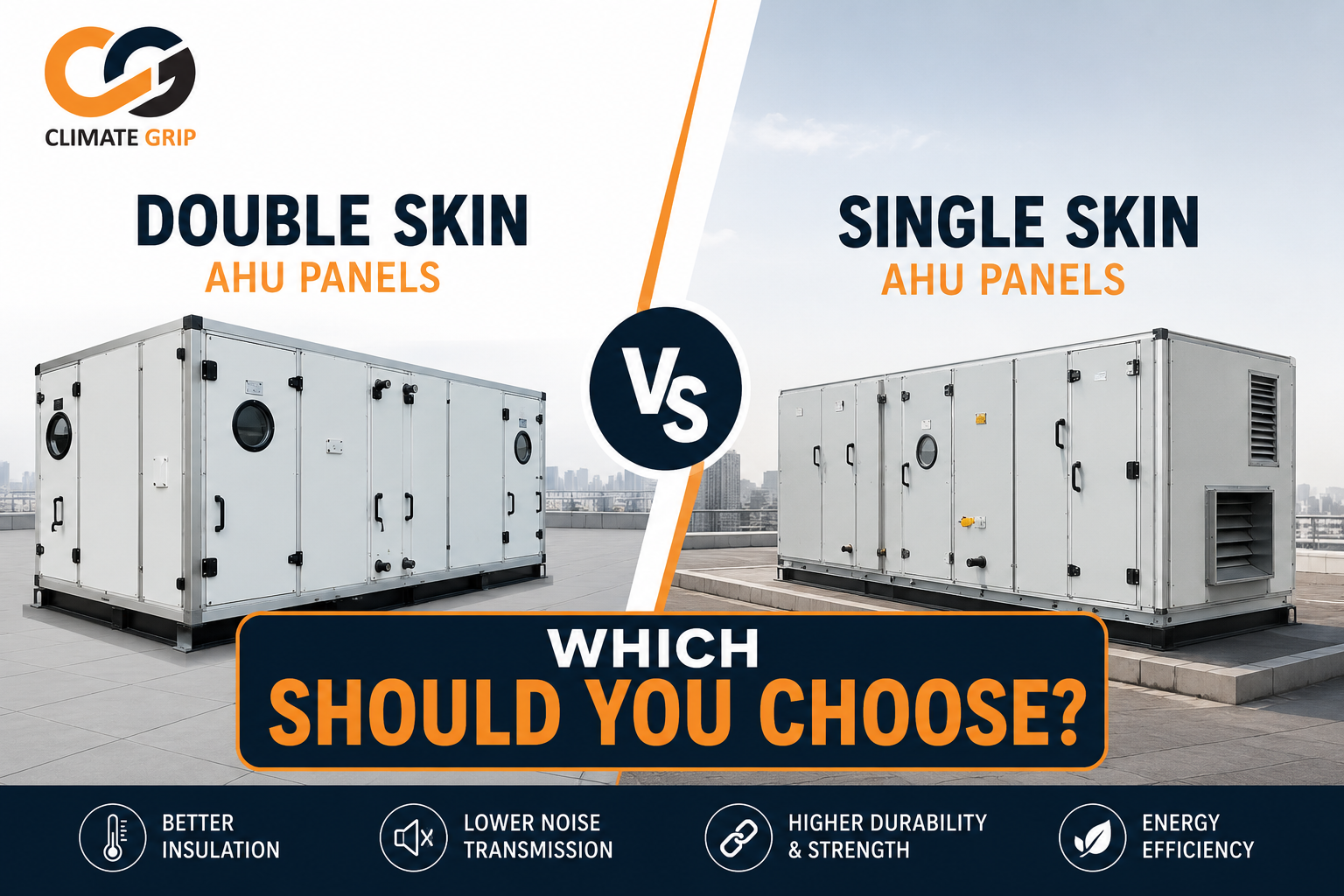
If you’re specifying or upgrading an Air Handling Unit (AHU), one of the first engineering decisions you’ll face is panel construction: single skin or double skin. It’s a choice that affects insulation, hygiene, noise, energy costs, and — for hospitals and pharmaceutical facilities — regulatory compliance. This guide breaks down the difference so you can choose the right panel type for your project, budget, and application.
What Is an AHU Panel and Why Does Construction Matter?
The panel is the outer casing of an Air Handling Unit — it houses the fans, filters, coils, and dampers, and forms the airtight envelope that keeps conditioned air from leaking out or contaminants from getting in. Panel construction directly determines three things: how much energy the unit wastes through heat transfer, how easy the unit is to keep clean and hygienic, and how much noise escapes the casing. Getting this choice right at the specification stage avoids costly retrofits later.
What Is a Single Skin AHU Panel?
Construction & Materials
A single skin panel uses one layer of galvanized steel or aluminum sheet mounted on a structural frame, typically with little to no insulation between the frame and the sheet. It’s a simpler, lighter-weight build.
Typical Applications
Single skin panels work well for low-risk comfort cooling — offices, retail spaces, and warehouses — where strict hygiene, noise control, and thermal insulation aren’t critical requirements.
What Is a Double Skin AHU Panel?
Construction & Materials
Double skin panels sandwich a layer of insulation — usually pressure-injected polyurethane foam (PUF) at 25mm or 50mm thickness and 38–40 kg/m³ density — between an inner and outer metal skin. The overlapping wedge-and-gasket joint design significantly reduces air leakage, and the smooth inner surface resists dirt and bacterial buildup.
Typical Applications
Double skin construction is the standard for hospitals, pharmaceutical clean rooms, operation theatres, laboratories, and any GMP or NABH-regulated environment where air quality, pressure control, and hygiene are non-negotiable.
Double Skin vs Single Skin AHU Panels: Key Differences
Here’s a side-by-side comparison across the factors that matter most when specifying a panel type:
| Parameter | Single Skin AHU Panel | Double Skin AHU Panel |
| Construction | Single layer of galvanized/aluminum sheet, no inner skin | Two metal skins with insulation sandwiched between (PUF core) |
| Insulation value | Low to moderate | High — reduces heat gain/loss significantly |
| Air leakage | Higher, more joints and seams | Very low, sealed overlapping panel joints |
| Hygiene / cleanability | Harder to keep contaminant-free, exposed frame | Smooth inner surface, easy to clean, no dirt traps |
| Noise level | Higher operational noise | Quieter due to insulation dampening |
| Condensation risk | Higher, especially in humid climates | Low, minimal cold bridging |
| Typical cost | Lower upfront cost | Higher upfront cost, better long-term ROI |
| Best suited for | Basic comfort cooling, low-risk commercial spaces | Hospitals, pharma clean rooms, GMP/NABH facilities |
Which Panel Type Is Best for Pharma & Healthcare Facilities?
For pharmaceutical and healthcare projects, double skin is effectively the only serious option. Regulatory frameworks such as Schedule M (GMP) and NABH accreditation require validated HVAC systems with controlled pressure cascades, HEPA filtration integrity, and minimal contamination risk — all of which depend on an airtight, easy-to-clean casing. The smooth inner surface of a double skin panel also aligns with ASHRAE 170 guidance for healthcare ventilation, since it doesn’t harbor dust or microbial growth the way an exposed single skin frame can.
Which Panel Type Is Best for Commercial & Industrial Use?
If you’re cooling a general office, retail unit, or light industrial space with no strict air-quality mandate, single skin panels are often the more cost-effective choice. The lower insulation value and higher air leakage are acceptable trade-offs when the priority is upfront budget rather than energy performance or hygiene compliance.
Cost Comparison — Is Double Skin Worth the Extra Investment?
Double skin panels cost more upfront, but the gap narrows — and often reverses — over the unit’s lifespan. Better insulation cuts cooling/heating energy losses, sealed joints reduce the load on fans working to compensate for leakage, and the durable, low-maintenance casing extends service life. For any facility running HVAC continuously, such as a hospital or 24/7 manufacturing plant, the energy savings alone typically justify the higher initial cost within a few years.
How to Choose the Right AHU Panel for Your Project
- Application type: Is airborne contamination control or pressure zoning a requirement? → Double skin
- Regulatory compliance: Does the project need Schedule M, GMP, or NABH sign-off? → Double skin
- Climate: High humidity or extreme temperature swings favor double skin’s superior insulation
- Noise sensitivity: Hospitals, labs, and offices near AHU rooms benefit from double skin’s sound dampening
- Budget constraints: For non-critical comfort cooling with a tight capex budget, single skin may suffice
- Long-term operating cost: Factor in energy savings over 10–15 years, not just sticker price
Frequently Asked Questions
Is double skin AHU better than single skin?
For hygiene-critical and energy-sensitive applications, yes — double skin panels offer better insulation, lower air leakage, and easier cleaning. For basic comfort cooling with no strict compliance needs, single skin can be a practical, lower-cost choice.
What is the standard thickness of a double skin AHU panel?
Most manufacturers, including Climate Grip, offer double skin panels in 25mm or 50mm thickness, with a polyurethane foam core density of 38–40 kg/m³, depending on the insulation and structural requirements of the project.
Do hospitals require double skin AHU panels?
While not always mandated by name, hospital HVAC systems generally need to meet hygiene, pressure control, and energy efficiency standards (such as NABH or ASHRAE 170) that double skin panels are specifically designed to satisfy — making them the de facto standard for healthcare projects.
How much more expensive is a double skin AHU?
Costs vary by project size and specification, but double skin units typically carry a higher upfront price due to the added insulation material and construction complexity. This is usually offset over time through lower energy consumption and reduced maintenance.
Can single skin AHU panels be used in clean rooms?
It’s not recommended. Clean rooms require airtight, easy-to-clean surfaces to maintain particle and microbial control, which single skin panels — with their higher leakage and less hygienic exposed framing — are not built to provide.
Conclusion — Talk to an AHU Expert
Choosing between single skin and double skin AHU panels comes down to what your facility can’t compromise on: budget, or air quality and energy performance. For hospitals, pharma plants, and clean rooms, double skin is the clear choice. For general comfort cooling, single skin can still get the job done affordably.
Still not sure which panel construction fits your project? Climate Grip’s engineering team can review your application, compliance requirements, and budget to recommend the right AHU panel specification — contact us for a free consultation.