
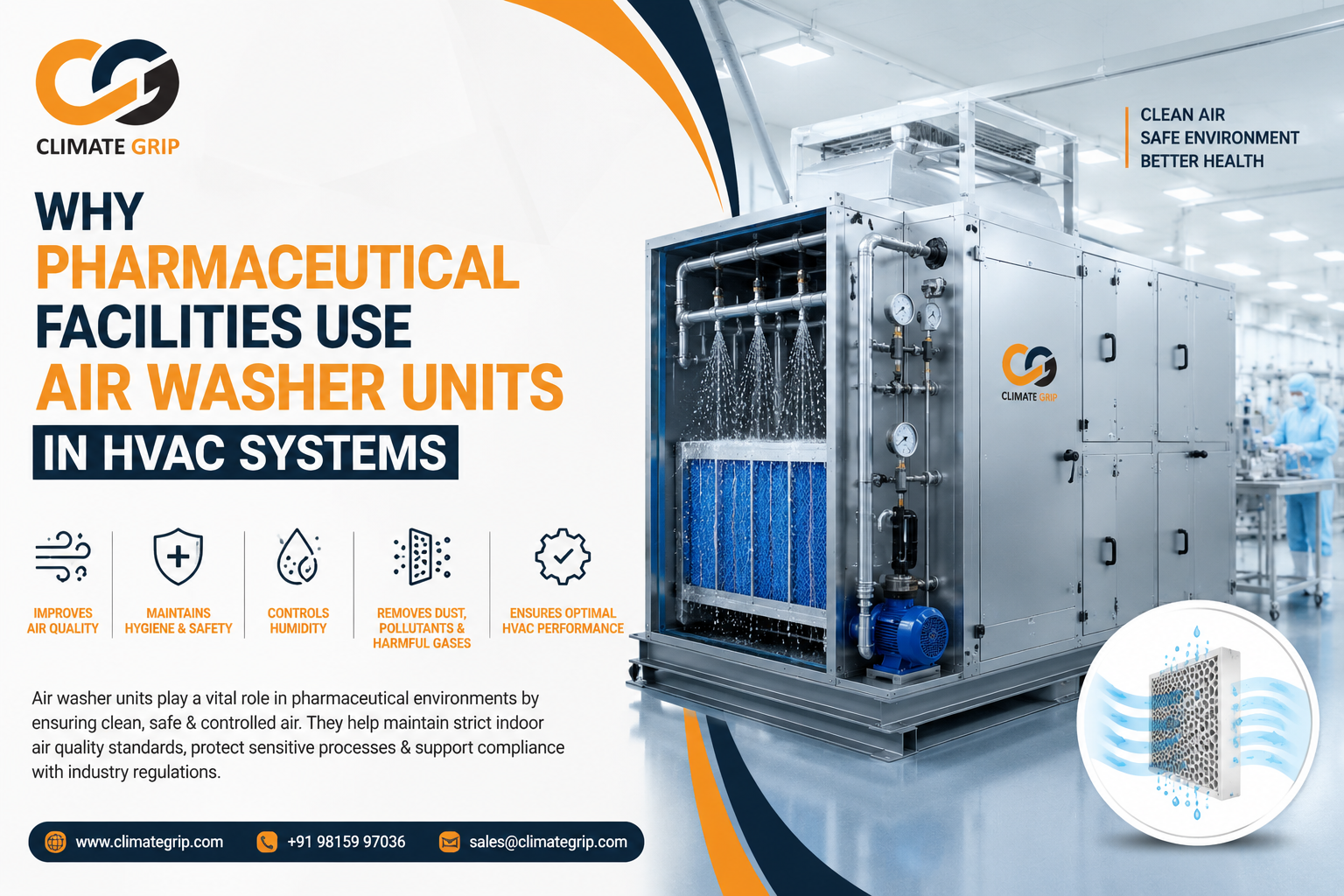
Pharmaceutical manufacturing leaves zero room for error when it comes to air quality. A single airborne contaminant can compromise product integrity, trigger regulatory non-compliance, or put patient safety at risk. That’s why facility engineers increasingly turn to the air washer unit in HVAC systems — a proven, water-based technology that cleans, cools, and humidifies air simultaneously. In this guide, we break down why pharma facilities rely on air washer units, how they compare to standard AHUs, and what to look for when choosing the right system for your plant.
What Is an Air Washer Unit in HVAC Systems?
An air washer unit is an HVAC component that uses water — rather than refrigerants or chemical filters — to clean, cool, and humidify incoming air. As air passes through a chamber of fine water droplets, dust, pollutants, and airborne particles are captured, while evaporative cooling naturally lowers the air temperature. Mist eliminators then remove excess moisture before the conditioned air is pushed into the ducting system. This makes air washer units a low-maintenance, energy-efficient alternative to conventional cooling and humidification setups — and a natural fit for pharmaceutical environments where both air purity and precise humidity matter.
The Air Quality Challenge in Pharmaceutical Manufacturing
Pharmaceutical production areas operate under some of the strictest environmental standards of any industry. Airborne particles, microbes, and humidity fluctuations can directly affect product stability, shelf life, and regulatory approval. Facilities must comply with cleanroom classifications and standards such as ISO 14644, which govern acceptable particle counts and air change rates (ACH) per hour. Meeting these benchmarks consistently — without driving up energy costs — is where the air washer unit earns its place in the HVAC design.
Top Reasons Pharmaceutical Facilities Rely on Air Washer Units
Sterile & Contamination-Free Air Supply
By trapping dust, pollutants, and particulate matter in water droplets before air reaches production areas, air washer units help facilities maintain the low-contamination environment required for compounding rooms, cleanrooms, and manufacturing floors.
Precise Humidity Control for Sensitive Formulations
Many pharmaceutical products — particularly oral solid dosage forms — are highly sensitive to humidity swings. Air washer units add moisture through evaporative action, giving facilities consistent, natural humidity control without relying on complex mechanical humidifiers.
Energy-Efficient Cooling Without Chemical Refrigerants
Because air washer units pre-condition air before it reaches cooling coils, the overall HVAC system works less hard to hit target temperatures. This reduces cooling load, lowers electricity consumption, and cuts down on refrigerant dependency — an increasingly important factor as facilities pursue sustainability targets.
Reduced Airborne Particles & Compliance with ACH Standards
Consistent particle removal supports the air change rates mandated by cleanroom classifications, helping facilities stay audit-ready and compliant with GMP and ISO 14644 requirements.
Cost-Effective Alternative to Complex Humidification Systems
With fewer moving parts than steam or ultrasonic humidifiers, air washer units are simpler to maintain, less prone to breakdown, and more cost-effective over the equipment’s lifetime — a meaningful advantage for large-scale pharma plants running HVAC systems around the clock.
Air Washer Unit vs AHU: What Pharma Facilities Should Know
Air washer units and air handling units (AHUs) often work together rather than as substitutes. An AHU regulates and distributes conditioned air throughout a facility, while an air washer unit specifically handles air cleaning, cooling, and humidification at the intake stage. In most pharmaceutical HVAC designs, the air washer unit pre-treats the air before it enters the AHU — combining the strengths of both systems to meet cleanroom-grade air quality.
- Air Washer Unit: Cleans, cools, and humidifies incoming air using water
- AHU: Regulates airflow, filtration, and distribution across the facility
- Best practice: Use both together for pharma-grade air quality and compliance
Where Air Washer Units Are Used in Pharma Facilities
- Cleanrooms and controlled manufacturing zones
- Compounding and formulation rooms
- Production floors handling oral solid dosage or sterile products
- Raw material and finished product storage areas
Key Features to Look for in an Air Washer Unit for Pharma HVAC
- Filtration standard aligned with cleanroom classification (ISO 14644)
- Corrosion-resistant, hygienic build material suited for pharma environments
- Capacity matched to facility air change rate (ACH) requirements
- Easy-access design for routine cleaning and maintenance
- Compliance certifications and validation support from the manufacturer
Choosing the Right Air Washer Unit Manufacturer
Since air washer units directly impact cleanroom compliance and product safety, the manufacturer’s engineering expertise matters as much as the equipment itself. Climate Grip designs and manufactures air washer units built specifically for pharmaceutical, industrial, and cleanroom applications — with attention to hygienic construction, energy efficiency, and compliance-ready performance.
Conclusion
For pharmaceutical facilities, the air washer unit in HVAC systems isn’t just an add-on — it’s a foundational component for maintaining sterile, humidity-controlled, and energy-efficient production environments. Whether you’re designing a new cleanroom HVAC system or upgrading an existing one, choosing the right air washer unit can directly impact product quality, compliance, and operating costs.
Looking for a reliable air washer unit for your pharmaceutical facility? Get in touch with Climate Grip’s HVAC engineering team to discuss a solution built for your compliance and capacity needs.
Frequently Asked Questions
What is the role of an air washer unit in pharmaceutical HVAC systems?
It cleans, cools, and humidifies incoming air using water, helping pharmaceutical facilities maintain contamination-free, humidity-controlled environments required for compliant manufacturing.
How does an air washer unit differ from an air handling unit (AHU)?
An air washer unit conditions and cleans air using water at the intake stage, while an AHU regulates and distributes that conditioned air throughout the facility. The two typically work together in pharma HVAC design.
Is an air washer unit suitable for cleanroom environments?
Yes. When paired with proper filtration and designed to meet ISO 14644 standards, air washer units support the low-particle, controlled-humidity conditions cleanrooms require.
What humidity level can an air washer unit maintain in pharma facilities?
Air washer units can be engineered to maintain the specific humidity range required by a facility’s product formulations, typically working within the standard 40–60% RH range common in pharmaceutical manufacturing.
Are air washer units cost-effective compared to traditional humidifiers?
Generally, yes. With fewer mechanical parts and lower energy demands than steam or ultrasonic humidifiers, air washer units tend to offer lower maintenance and operating costs over time.
Which industries besides pharma use air washer units?
Air washer units are widely used in textile and spinning units, food processing plants, and commercial buildings — anywhere air purification and humidity control are priorities.