
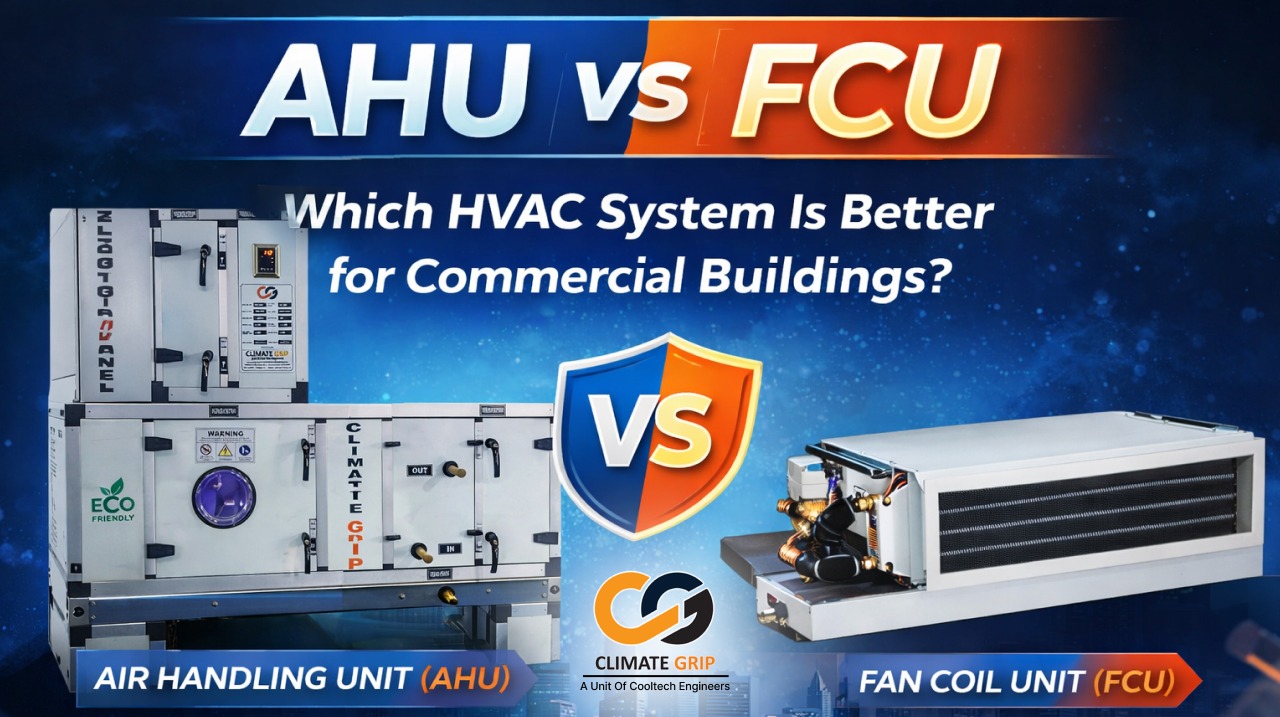
Choosing between AHUs and FCUs is one of the most common decisions in commercial HVAC design. Whether you are planning an office tower, hospital, hotel, shopping mall, or industrial facility, understanding the differences between AHUs and FCUs helps you select the right system for comfort, indoor air quality, and energy efficiency.
Both systems are widely used in commercial buildings, but they serve different purposes. In this guide, we’ll explain how they work, compare their performance, and help you decide which system is best for your project.
What Is an AHU? (Air Handling Unit)
An Air Handling Unit (AHU) is a centralized HVAC component that conditions and circulates air throughout a building. It is typically installed in a mechanical room, on a rooftop, or on a dedicated AHU floor.
AHU Meaning in HVAC
In HVAC systems, an AHU is responsible for:
- Bringing in fresh outdoor air
- Filtering air
- Heating or cooling air
- Controlling humidity (in advanced systems)
- Distributing air via ductwork
Main AHU Components
A typical AHU includes:
- Air filters (pre-filters, fine filters, HEPA if required)
- Cooling and/or heating coils
- Supply and return fans
- Mixing box (for fresh and return air)
- Dampers and control systems
- Humidifier/dehumidifier (optional)
AHUs are commonly used in large commercial buildings, hospitals, malls, airports, and industrial facilities where centralized air management and ventilation are critical.
What Is an FCU? (Fan Coil Unit)
A Fan Coil Unit (FCU) is a decentralized HVAC unit that heats or cools a specific room or zone. It is usually installed inside ceilings or mounted in rooms. FCU Meaning in HVAC
An FCU:
- Recirculates indoor air
- Passes air over a cooling or heating coil
- Uses chilled or hot water supplied from a central plant
- Allows room-level temperature control
Main FCU Components
- Fan
- Heating/cooling coil
- Basic air filter
- Drain pan
- Thermostat or room controller
FCUs are commonly used in:
- Hotel rooms
- Offices with multiple cabins
- Apartments
- Hospitals (in certain non-critical zones)
Unlike AHUs, FCUs generally do not supply fresh air. They mainly condition the air already inside the room.
Difference between AHU and FCU
Understanding the differences between AHUs and FCUs is essential for selecting the right system.
1. Function
- AHU: Handles ventilation, filtration, and centralized air conditioning.
- FCU: Provides localized heating or cooling within a specific room.
2. Fresh Air Supply
- AHU: Supplies treated fresh air from outside.
- FCU: Typically recirculates room air and requires a separate ventilation system.
3. Installation Location
- AHU: Installed in plant rooms, rooftops, or mechanical floors.
- FCU: Installed inside rooms or above ceilings.
4. Control
- AHU: Centralized control system.
- FCU: Individual room-level control.
5. Maintenance
- AHU: Centralized maintenance but larger equipment.
- FCU: Multiple smaller units require distributed maintenance.
6. Ducting vs Piping
- AHU: Requires extensive ductwork.
- FCU: Requires chilled/hot water piping.
In simple terms, AHUs are best for centralized ventilation and air management, while FCUs are best for zoning and room-wise comfort control.
AHU vs FCU for Commercial Buildings
When deciding AHU vs FCU for commercial buildings, several factors must be considered:
1. Building Size
- Large open spaces → AHU preferred.
- Multiple independent rooms → FCU preferred.
2. Indoor Air Quality Requirements
If the building requires:
- High fresh air supply
- Advanced filtration
- Humidity control
Then AHU is essential.
3. Zoning Requirements
Hotels, multi-tenant offices, and apartments often require:
- Individual temperature control
- Energy-saving through occupancy-based control
FCUs are ideal for such applications.
4. Budget Considerations
- AHUs may have higher ducting costs.
- FCUs may have higher piping and distributed maintenance costs.
The final decision depends on the project’s ventilation, comfort, and control needs.
AHU vs FCU Energy Efficiency
Energy efficiency is a significant consideration in commercial HVAC.
AHU Energy Factors
- Fan power consumption
- Filter pressure drop
- Ventilation load (cooling/heating outdoor air)
- Humidity control energy
AHUs may consume more energy due to ventilation requirements, but they are necessary where fresh air is mandatory.
FCU Energy Factors
- Multiple fan motors across rooms
- Chilled water pumping energy
- Room-level thermostat control
FCUs can save energy in low-occupancy areas by allowing individual rooms to be switched off.
Improving Efficiency in Both Systems
- Use Variable Frequency Drives (VFDs)
- Optimize chilled water temperature
- Maintain clean filters and coils
- Use innovative building automation systems
- Avoid over-ventilation
The honest answer to the question of AHU vs FCU energy efficiency depends on system design, controls, and maintenance quality.
AHU vs FCU for Hospital HVAC
Hospitals have strict air quality and infection control requirements.
Why AHU Is Critical in Hospitals
- High fresh air changes per hour
- HEPA filtration
- Pressure control (positive/negative rooms)
- Temperature and humidity regulation
In critical areas such as operating theatres and ICUs, AHUs are essential. Role of FCUs in Hospitals
FCUs may be used in:
- Administrative areas
- Non-critical patient rooms
- Office spaces
For hospital HVAC systems, AHUs are usually the backbone, while FCUs support comfort in selected zones.
AHU vs FCU for Hotel Rooms
Hotels require guest comfort and individual control.
Why FCUs Are Common in Hotels
- Individual room temperature control
- Energy savings when rooms are unoccupied
- Quiet operation (if properly designed)
Role of AHU in Hotels
AHUs or Fresh Air Handling Units (FAHU) typically:
- Supply fresh air to corridors and rooms
- Maintain ventilation standards
In most hotel projects, the best solution is a combination of AHU (for ventilation) and FCU (for room comfort).
Can AHU and FCU Work Together?
Yes, and in many commercial buildings, they do.
Typical Combined System Design
- AHU supplies treated fresh air to zones.
- FCUs handle room-level cooling/heating.
Benefits of Combining AHU and FCU
- Proper ventilation
- Better temperature zoning
- Improved indoor air quality
- Optimized energy performance
Common Mistakes to Avoid
- Insufficient fresh air supply
- Poor control integration
- Improper condensate drainage in FCUs
- Oversizing equipment
- For most commercial buildings, combining both systems offers the best balance between ventilation and comfort.
Quick Decision Checklist
Choose AHU if:
- Your building requires a high fresh air supply.
- You need centralized filtration and humidity control.
- You manage large, open spaces, such as malls or airports.
Choose FCU if:
- You need room-wise temperature control.
- The building has multiple independent zones.
- Energy savings from occupancy-based control are essential.
Choose Both if:
- You need ventilation + zoning.
- You are designing hotels, hospitals, or large office complexes.
- You want balanced comfort and compliance.
Frequently Asked Questions
Conclusion
When comparing AHUs vs. FCUs, the right choice depends on your building’s size, ventilation requirements, zoning needs, and energy goals.
- AHUs are ideal for centralized air management and fresh air supply.
- FCUs are perfect for localized comfort and temperature control.
- In many commercial buildings, combining both systems delivers the best results.
If you are planning a commercial HVAC project and need expert guidance on selecting between AHUs and FCUs, consult experienced HVAC professionals to ensure optimal design, performance, and compliance.
A properly designed HVAC system is not just about cooling—it’s about comfort, air quality, energy efficiency, and long-term reliability.