
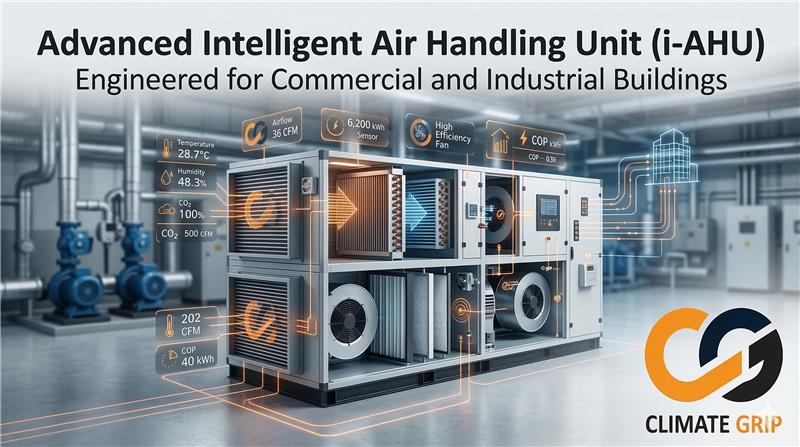
Modern commercial and industrial buildings demand more than just basic heating, ventilation, and air conditioning. They require smarter, more responsive systems that can maintain indoor comfort, protect air quality, reduce operating costs, and support sustainability goals. This is where the Intelligent Air Handling Unit (i-AHU) stands out as a next-generation solution.
An Advanced Air Handling Unit is no longer limited to simply moving and conditioning air. Today’s systems are designed to think, adapt, and perform with greater precision. With integrated controls, smart sensors, and automated performance monitoring, an Intelligent Air Handling Unit helps businesses achieve better indoor environments while using energy more efficiently.
For commercial complexes, hospitals, hotels, factories, warehouses, and manufacturing plants, the need for high-performance and reliable HVAC infrastructure continues to grow. An Energy Efficient Air Handling Unit answers this need by combining intelligent control with operational excellence. As a result, Intelligent HVAC Solutions are becoming essential for buildings that want to stay productive, compliant, and future-ready.
What is an Intelligent Air Handling Unit (i-AHU)?
An air handling unit is one of the most important components in an HVAC system. It is responsible for circulating, filtering, heating, cooling, and regulating air within a building. Traditional AHUs perform these core functions, but they often rely on fixed settings and limited control mechanisms.
An Intelligent Air Handling Unit goes far beyond conventional performance. It uses advanced technology such as real-time sensors, automated control systems, variable-speed components, and digital monitoring tools to optimize airflow and environmental conditions. Instead of running at constant levels regardless of actual demand, an i-AHU adjusts its performance based on occupancy, air quality, temperature, humidity, and energy usage.
This intelligent operation makes the system more responsive and far more efficient. A well-designed Advanced Air Handling Unit can reduce waste, improve comfort, and deliver more consistent air management across different zones and operating conditions. In both commercial and industrial buildings, that level of precision can make a major difference.
Why Commercial and Industrial Buildings Need Advanced Air Handling Units
Commercial and industrial spaces have far more complex ventilation and climate requirements than small residential buildings. A shopping mall, hospital, office tower, data facility, pharmaceutical plant, or warehouse each has different occupancy levels, operational schedules, and air quality needs. These environments cannot rely on outdated HVAC equipment that lacks flexibility.
A Commercial Air Handling Unit must provide stable indoor comfort for employees, visitors, customers, and tenants. In offices, proper ventilation improves comfort and concentration. In hotels, it enhances guest experience. In hospitals, air control is directly linked to hygiene and patient safety. In retail centers, consistent temperature and fresh airflow influence both customer satisfaction and equipment performance.
At the same time, an industrial environment demands even greater durability and control. An industrial facility may generate heat, dust, fumes, moisture, or airborne particles that require constant management. This is why an intelligent system is so valuable. An Intelligent Air Handling Unit can respond dynamically to heavy workloads, changing ambient conditions, and strict compliance standards.
Whether used as a Commercial Air Handling Unit or in a demanding industrial setting, the i-AHU supports reliable performance, lower energy waste, and better environmental control.
Key Features of an Advanced Intelligent Air Handling Unit
One of the major advantages of an Advanced Air Handling Unit is the range of smart features it brings to building operations.
- Smart Automation and Controls : Smart automation allows the unit to continuously assess indoor conditions and adjust accordingly. Sensors can monitor temperature, humidity, pressure, airflow, and air quality in real time. Based on this data, the unit can automatically optimize fan speed, fresh air intake, and cooling or heating output.
This reduces the need for constant manual intervention and helps ensure more stable performance. It also allows facility managers to identify issues faster and maintain better control over the HVAC network. - Energy Efficiency : An Energy Efficient Air Handling Unit is designed to reduce unnecessary power consumption. It operates according to actual building demand rather than fixed assumptions. If a zone has lower occupancy or reduced ventilation needs, the system can scale back automatically.
This intelligent energy management helps reduce utility bills while also supporting sustainable building practices. Over time, the savings from energy optimization can be substantial, especially in large facilities that operate for long hours. - Improved Indoor Air Quality : Indoor air quality is a major priority in both commercial and industrial buildings. An i-AHU helps improve air quality by optimizing filtration, controlling humidity, and ensuring an appropriate mix of fresh and recirculated air.
This is particularly important in environments such as hospitals, laboratories, educational institutions, food processing units, and manufacturing spaces. Better indoor air quality supports health, comfort, compliance, and productivity. - High Performance and Reliability : A modern Advanced Air Handling Unit is engineered for robust and continuous operation. Commercial and industrial buildings often require HVAC systems that can run efficiently under varying loads and challenging conditions. Intelligent monitoring helps reduce strain on system components and maintain long-term performance.
This not only extends equipment life but also reduces the risk of unexpected downtime.
Benefits of Intelligent HVAC Solutions in Modern Buildings
The adoption of Intelligent HVAC Solutions offers clear business and operational benefits.
First, intelligent systems significantly lower energy usage. Since HVAC is one of the largest contributors to a building’s operating expenses, efficiency improvements have a direct impact on cost control.
Second, these systems improve occupant comfort. Stable temperature, balanced airflow, and cleaner indoor air create healthier and more pleasant environments for workers, customers, and visitors.
Third, maintenance becomes easier and more proactive. Many intelligent systems can detect performance irregularities before they lead to failure. This predictive capability helps maintenance teams fix small issues early and avoid major repairs later.
Fourth, intelligent HVAC supports sustainability. Companies are under growing pressure to reduce emissions and improve energy performance. An Energy Efficient Air Handling Unit contributes to greener operations without sacrificing performance.
Finally, intelligent systems improve operational visibility. With better monitoring and data insights, facility managers can make informed decisions, optimize schedules, and align HVAC performance with broader building management goals.
Applications of i-AHU in Commercial Buildings
The Commercial Air Handling Unit plays a vital role in a wide range of building types. In office buildings, it helps maintain a productive environment by regulating fresh air supply and temperature throughout the workday. In shopping malls and retail spaces, it supports customer comfort and protects temperature-sensitive infrastructure.
In hospitals and healthcare facilities, intelligent air management is even more critical. These environments require strict control over ventilation, filtration, and pressure conditions to protect patients and staff. Hotels also benefit from intelligent AHUs by providing consistent comfort across guest rooms, lobbies, restaurants, and event spaces.
Educational institutions, airports, convention centers, and mixed-use developments are also ideal settings for the use of an Intelligent Air Handling Unit, especially where occupancy levels vary throughout the day.
Applications of i-AHU in Industrial Buildings
Industrial environments often place more extreme demands on HVAC systems. Manufacturing plants may need to handle heat loads, airborne particles, process-related moisture, or specialized ventilation requirements. Warehouses and logistics centers may need stable climate control across vast areas. Food processing facilities and pharmaceutical plants often operate under strict environmental and hygiene standards.
In such conditions, an Advanced Air Handling Unit provides the flexibility and performance needed to maintain reliable operation. Its intelligent controls can adapt to changing workloads, detect inefficiencies, and support better process stability.
This makes the i-AHU an excellent fit for industries that depend on consistent environmental conditions, product quality, and worker safety.
How an Energy Efficient Air Handling Unit Reduces Operating Costs
Reducing operating costs is one of the strongest reasons to invest in an Energy Efficient Air Handling Unit. Traditional systems often run harder than necessary, wasting electricity through fixed-speed fans, inefficient airflow control, and delayed maintenance.
An intelligent system improves this in several ways. It optimizes fan performance based on real-time demand, reduces over-conditioning, improves heat recovery opportunities, and minimizes energy loss through smarter control logic. It can also support predictive maintenance, which helps prevent costly failures and emergency service interruptions.
The result is not just short-term utility savings but also long-term return on investment. Businesses gain lower lifecycle costs, more reliable equipment performance, and better value from their HVAC infrastructure.
Choosing the Right Intelligent Air Handling Unit
Selecting the right Intelligent Air Handling Unit requires a careful understanding of building needs. Factors such as airflow requirements, building size, occupancy patterns, indoor air quality standards, and energy goals all matter.
For commercial spaces, comfort and zoning flexibility may be the main priorities. For industrial sites, the focus may be on durability, contamination control, and continuous heavy-duty operation. The right Advanced Air Handling Unit should also integrate well with building management systems and offer easy access for maintenance and service.
Choosing a solution with strong engineering, dependable controls, and future-ready features ensures better long-term performance.
The Future of Intelligent HVAC Solutions
The future of Intelligent HVAC Solutions is closely tied to automation, connectivity, and sustainability. As buildings become smarter, HVAC systems will continue evolving through AI-driven control strategies, IoT-based monitoring, and deeper integration with centralized building management platforms.
This will allow the Intelligent Air Handling Unit to become even more adaptive, efficient, and data-driven. It will not only respond to current building conditions but also help predict future demand, identify performance trends, and support strategic facility planning.
For commercial and industrial buildings alike, the move toward intelligent ventilation is no longer optional. It is quickly becoming the standard for modern, efficient, and responsible building operation.
Conclusion
The Advanced Intelligent Air Handling Unit (i-AHU) represents a major step forward in HVAC performance for commercial and industrial buildings. It combines automation, energy optimization, air quality control, and reliable operation into one powerful system.
From offices and hospitals to factories and warehouses, the Intelligent Air Handling Unit delivers the performance today’s buildings need. As a Commercial Air Handling Unit and a smart industrial HVAC solution, it supports healthier indoor environments, lower operating costs, and more efficient building management.
In an era where efficiency, sustainability, and operational intelligence matter more than ever, investing in an Energy Efficient Air Handling Unit is a smart decision. Businesses that adopt Intelligent HVAC Solutions today are building a stronger, smarter, and more future-ready tomorrow.